

Commercial Firm Government Contracting Strategy: The Buy-Side Reality Check for 2026

Article by
Nikki Gianni
Nikki Gianni is a seasoned business strategist and government contracts coach, dedicated to helping businesses successfully navigate the complexities of government contracting. With over 22 years of experience in Department of Defense contracting, including managing $20 billion in federal awards, Nikki has developed the innovative GovReady Blueprint™ Framework, a comprehensive 90-day program designed to prepare businesses to compete for and win lucrative contracts at the federal, state, and local levels. Nikki's approach emphasizes not just gaining contracts but also enhancing overall business profitability.
Before becoming a business owner, Nikki was active-duty Air Force for 10 years, then spent another 15 years as a civil servant with the DOD. Now she's an empty nester living in Southern California who loves spending time with her 22-year-old son, Lex and her 2 Mini Aussies, Tony & Carmela, doing home improvement and crafts projects, and networking.
What if your greatest commercial strength is actually your federal poison? You’ve spent years building a $10M powerhouse, yet you’re losing bids to firms with half your talent and a fraction of your drive. It’s maddening, and frankly, you deserve better than to be ignored by the largest buyer on the planet. To win, your commercial firm government contracting strategy must shift from a sales pitch to a clinical exercise in risk removal. You likely followed the generic advice to "just get certified" and waited for the phone to ring. It didn't. That’s because the government doesn't buy your "innovation" or your "disruptive" culture. They buy the absence of problems. At The GovCon Architect, we understand the sting of being a high-performer ignored by a system that values paperwork over results. This article explains the "why" behind government rejections and provides a repeatable framework to transform your firm into a low-risk, compliant bidder. We’re moving beyond the marketing fluff to help you master the Buy-Side reality so you can finally start winning. It’s about becoming the safest bet in the room.
Key Takeaways
- Stop assuming your commercial trophy case translates to federal wins; federal buyers don't care about your "disruptive" spirit, they care about not getting fired.
- Build a defensible commercial firm government contracting strategy that treats procurement as a clinical exercise in risk removal rather than a standard sales pitch.
- Decode the evaluator's mindset to understand the "why" behind seemingly redundant data requests and start speaking the language of the Buy-Side.
- Implement a clinical "Agility Audit" and a ruthless no-bid framework to stop wasting time on agencies that don't value your specific commercial expertise.
The Buy-Side Reality Check: Why Commercial Dominance Fails in Federal Bids
You’ve built a $5M+ empire. You’re the big fish in your local pond. Then you hit the federal wall and realize your commercial marketing is just expensive noise. In the federal market, a commercial firm government contracting strategy isn't about being the loudest; it's about being the quietest risk in the room. At The GovCon Architect, we want you to win, but you have to stop playing by private sector rules. Your commercial clients love your agility; the government sees that same agility as a lack of disciplined process. Thinking a certification wins contracts is like thinking a gym membership makes you an athlete. It's a prerequisite, not a strategy.
The Disconnect Between Commercial Value and Federal Risk
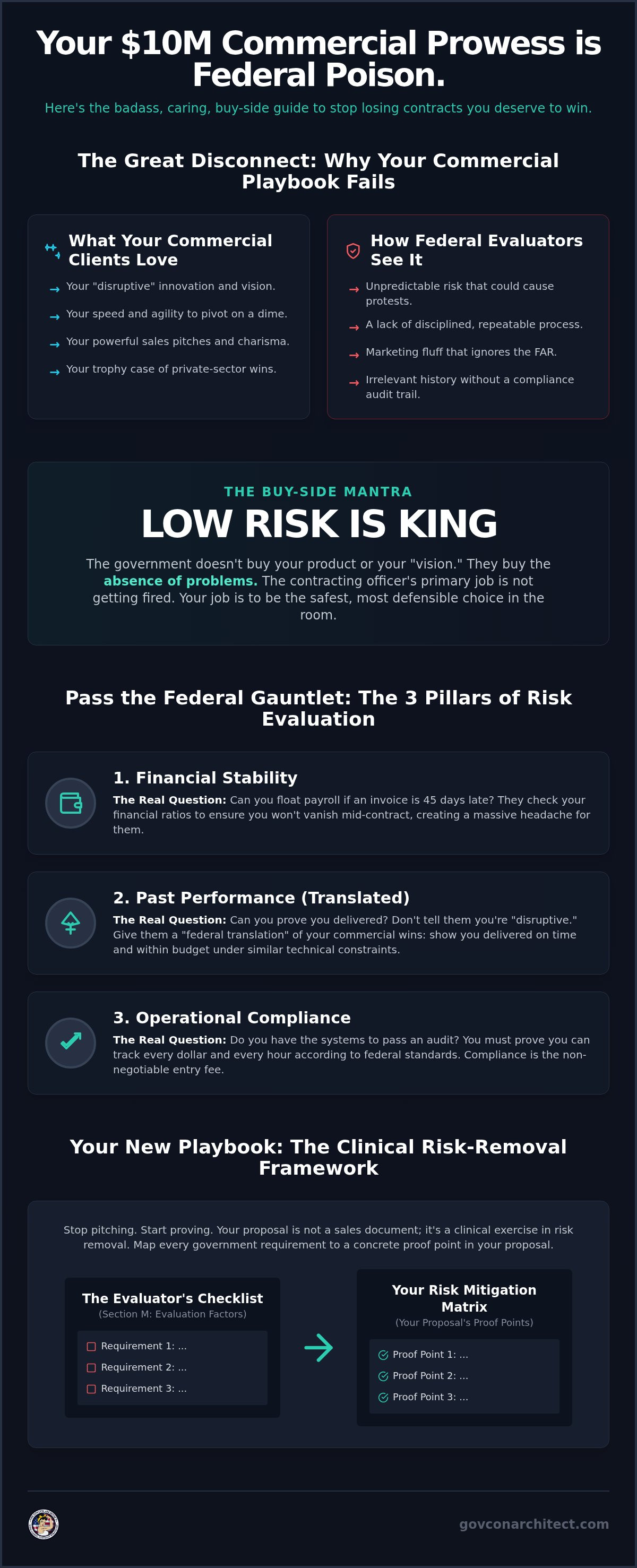
Commercial clients pay for innovation and speed. Federal buyers pay for stability and defensibility. "The Buy-Side" is the perspective of the government evaluator who must justify every award decision to their superiors. If they pick you and you fail, it's their neck on the line. This disconnect is one of the primary reasons for losing government contracts: you sold them on your vision when they just wanted to see an audit trail.
Why "Low Risk is King" in 2026
Contracting Officers (KOs) are risk managers with checkbooks. They don't have a vision board for your startup; they have the Federal Acquisition Regulation (FAR). In 2026, with budgets tightening, they aren't looking for the "best" solution. They’re looking for the one that won't result in a protest. You must identify hidden risk factors in your commercial approach, like non-compliant accounting or unstable supply chains, and neutralize them before you ever hit submit.
Decoding the Evaluator Mindset: How the Government Scores Your Strategy
The person scoring your proposal isn't a fan; they’re a bureaucrat looking for a reason to say "no." To them, your commercial firm government contracting strategy is a puzzle of potential failures. They ask for seemingly redundant data because they need a verifiable audit trail that survives a legal protest. The DCMA Commercial Item Group exists to ensure the government doesn't overpay or take on undue risk when buying commercial items. They aren't being difficult; they’re being defensible. Low risk is king, and compliance is merely the entry fee. If you can't prove stability, you're a liability.
The Three Pillars of Federal Risk Evaluation
The government evaluates your firm across three critical dimensions. First is financial stability. Can you float the payroll if an agency is 45 days late on a payment? They check your ratios to ensure you won't go dark mid-contract. Second is past performance. Your commercial wins need "federal translation." Don't tell them you’re "disruptive." Show them you delivered on time and within budget under similar technical constraints. Finally, operational compliance requires proving you have systems to track every dollar and hour according to federal standards.
Mapping Your Strategy to Evaluation Criteria
Evaluators use Section L (Instructions) and Section M (Evaluation Factors) as filters. If you miss a minor formatting rule in Section L, you might be disqualified before they even read your solution. This isn't personal; it's procedural. If you can't follow instructions on page 10, they assume you won't follow the contract on day 100. This is where a clinical Government Contract Competitive Analysis becomes mandatory. You must build a "Risk Mitigation Matrix" that maps every requirement in Section M to a specific proof point in your proposal. If you're tired of guessing why you're losing despite your $5M revenue, it might be time to book a strategy briefing to align your commercial success with federal reality.
Core Components of a Defensible Commercial Firm Government Contracting Strategy
Stop throwing spaghetti at the wall and hoping it sticks to the Pentagon. A real commercial firm government contracting strategy relies on clinical market intelligence, not lucky guesses at USAspending. You need to know which agencies have the budget and the actual intent to buy before you waste a single billable hour. Implementation of a "No-Bid" framework is your secret weapon; it saves your team from the soul-crushing burnout of chasing "wired" contracts. Sometimes the most profitable move is walking away from a requirement that’s clearly built for an incumbent. Capture management isn't a dark art; it’s just getting to the requirement before it’s a public RFP. You want to influence the "why" before the "how" is set in stone.
Aligning Commercial Capabilities with Federal Needs
Your commercial wins are gold, but they need a federal polish. You must translate your private sector speed into a low risk bidder strategy that prioritizes stability. At The GovCon Architect, we love your ambition, but we don’t waste time providing generic capability statement templates that end up in an evaluator's shredder. We build the underlying strategy that makes those documents actually perform. It’s about proving you’re a safe bet, not just a fast one. The government wants to see that you understand their unique constraints without needing a hand-held tour of the regulations.
The Role of a Fractional Federal Strategy Advisor
If you’ve been delivering for 5+ years and hit the $5M mark, you’re ready for a serious seat at the table. You need a Fractional Federal Strategy Advisor who brings the "Buy-Side" perspective to every pursuit. This isn't about ad-hoc, "lottery ticket" bidding that leaves your team cynical. Consistency is the only way to build a repeatable revenue channel. A RETAINER · MONTHLY commitment ensures you have an insider architecting your moves, not just reacting to the market. It’s the difference between guessing your way through a bid and knowing exactly how the evaluator will score your risk profile.
Implementing Your Market Entry: From Commercial Success to Federal Wins
Anyone telling you that you’ll win your first federal contract in 30 days is either lying or trying to sell you a bridge. Real market entry is a clinical process, not a sprint. Your commercial firm government contracting strategy begins with a brutal Agility Audit to see if your $5M+ operation can actually survive federal scrutiny. After the audit, you identify the specific agencies that value your commercial delivery model. You don't chase every shiny RFP; you build a 6 to 12 month roadmap for strategic engagement. This roadmap involves mapping agency fiscal cycles and pre-positioning your past performance before the solicitation hits the street. You then execute a PROJECT · 90-120 DAYS – Federal Market Entry Engagement to ensure your systems, narratives, and pricing are defensible before you hit "submit."
What a Real Federal Market Entry Engagement Looks Like
A real engagement moves you from being merely "SAM registered" to being strategically aligned. In 120 days, we translate your commercial wins into the language of risk mitigation. We require a 3-month minimum commitment because that’s how long it takes to build a foundation that won't crumble under the first audit. You aren't just bidding; you're positioning your firm as the only logical, low-risk choice for the government buyer. This is about structural integrity, not marketing fluff.
Taking the Next Step: The Buy-Side Advantage
GovCon Architect isn't for startups or pre-revenue dreamers. We serve established firms with $5M+ in revenue and 5+ years of delivery who are tired of losing. We offer the Buy-Side Advantage because we’ve sat in the evaluator's chair and awarded the contracts you're chasing. If you’re ready to stop guessing, book a 15-minute call to assess your commercial firm government contracting strategy and bid readiness. We’ll be blunt about whether you’re ready to compete or if your current approach is a liability.
Book your strategy briefing with GovCon Architect
Secure Your Seat at the Federal Table
You’ve spent years building a $5M+ powerhouse. Don't let a poorly designed expansion turn your federal goals into an expensive hobby. We've shown you that the Buy-Side doesn't care about your commercial innovation; they care about their own career safety. A winning commercial firm government contracting strategy is built on clinical risk removal and understanding the "why" behind every evaluation factor. You have the roadmap. Now you have to decide if you're going to keep guessing or if you're ready to build a defensible revenue channel.
Nikki Gianni brings 22 years of Buy-Side experience to your corner. She's awarded the contracts you want and rejected the firms that lacked a real strategy. We don't waste your time with generic templates because your business isn't a commodity. We provide high-level strategy for established leaders who are finished with the "just get certified" nonsense. You have the delivery track record. It’s time to give you the architectural integrity to match it.
It's time to stop playing the federal lottery and start playing the long game. You're closer than you think.
Frequently Asked Questions
Is government contracting worth it for a successful commercial firm in 2026?
Yes, but only as a long-term revenue channel. Federal spending reached $813 billion in FY 2025, and 2026 is pacing even faster. For your commercial firm government contracting strategy, the scale is massive. We want you to win, but you must accept that the government buys based on risk removal. If you aren't ready for the "low risk is king" reality, you're just donating your time to the bureaucracy.
How much revenue does my firm need to be competitive in the federal market?
You need a minimum of $5M in annual revenue and 5 years of delivery to be competitive in our world. Why? Because the government's "low risk is king" mantra means they look for established stability. Smaller firms often lack the infrastructure to handle federal compliance or the cash flow for slow payment cycles. We focus on proven leaders because that’s who the Buy-Side actually trusts with high-stakes contracts.
Why do commercial firms often get disqualified from federal bids?
Disqualification isn't personal; it's procedural. Commercial firms fail because they sell "innovation" when the evaluator wants "risk mitigation." If you ignore a formatting rule in Section L or fail to prove financial responsibility, you're out. The government does this because they need a defensible audit trail that survives legal protests. They aren't being mean; they’re protecting their own jobs by ensuring every award is legally bulletproof and low-risk.
How long does a typical federal market entry strategy take to implement?
A legitimate federal market entry takes 90 to 120 days to build and 6 to 12 months to see optimum results. Forget the "30-day shortcut" lies; they don't exist in a system governed by the FAR. You need this time to audit your commercial systems and translate your wins into federal language. We care about your balance sheet, so we won't pretend this is a sprint. It’s a clinical exercise in positioning.
What is the difference between a proposal writer and a federal strategy advisor?
A proposal writer is a stenographer; a federal strategy advisor is an architect. Writers follow your lead, but an advisor with 22 years of Buy-Side experience tells you where the traps are hidden. Your commercial firm government contracting strategy needs an insider who knows "why" the government scores bids a certain way. We don't do generic templates. We build the high-level strategy that makes your $5M+ firm the only safe bet.