

Avoiding Personal Conflicts of Interest in Federal Contracting: The Buy-Side Reality Check

Article by
Nikki Gianni
Nikki Gianni is a seasoned business strategist and government contracts coach, dedicated to helping businesses successfully navigate the complexities of government contracting. With over 22 years of experience in Department of Defense contracting, including managing $20 billion in federal awards, Nikki has developed the innovative GovReady Blueprint™ Framework, a comprehensive 90-day program designed to prepare businesses to compete for and win lucrative contracts at the federal, state, and local levels. Nikki's approach emphasizes not just gaining contracts but also enhancing overall business profitability.
Before becoming a business owner, Nikki was active-duty Air Force for 10 years, then spent another 15 years as a civil servant with the DOD. Now she's an empty nester living in Southern California who loves spending time with her 22-year-old son, Lex and her 2 Mini Aussies, Tony & Carmela, doing home improvement and crafts projects, and networking.
Your dream hire, that former agency superstar, isn't a strategic asset to a Contracting Officer. They're a ticking career-ending bomb. In the federal market, the government buyer doesn't care about your aggressive growth goals. They care about their own job security. If your proposal smells like a Procurement Integrity Act violation, it goes straight into the shredder. Prioritizing avoiding personal conflicts of interest in federal contracting is the only way to stay in the game. Low risk is king. Period.
It's frustrating to feel like you're walking through a minefield just to hire talent. We get it. You want the best team, but FAR Part 3 feels like it's written in a different language. This article is your reality check. You'll learn the clinical mechanics to keep your firm in the "safe" pile. We're breaking down the $250,000 threshold, the mandatory reporting windows, and the internal protocols required to neutralize risks before they become protests. It's time to build a defensible architecture that lets you hire the best without the fear of accidental disqualification.
Key Takeaways
- Understand why a Contracting Officer views your "strategic hire" as a potential career-ender; protect your bid by adopting a buy-side mindset.
- Conduct a tactical audit to spot the "Former Fed" traps and financial red flags that trigger immediate disqualification in competitive procurements.
- Implement clinical mitigation strategies, such as employee firewalls and proactive disclosure, to maintain your status as the lowest-risk bidder in the room.
- Learn how avoiding personal conflicts of interest in federal contracting creates a defensible architecture that protects your long-term revenue and strategic growth.
The Buy-Side Reality: Why Personal Conflicts of Interest are Bid Killers
A Contracting Officer (KO) isn't looking for reasons to hire you. They're looking for reasons to disqualify you. It's safer for them. A Personal Conflict of Interest (PCI) is the perfect excuse. It isn't just about a bribe in a parking garage. It's about anything that makes the KO's boss, or the GAO, look twice. On the Buy-Side, the appearance of impropriety is just as lethal as a criminal act. For firms with $5M+ in revenue, the stakes are too high for accidental errors.
KO's don't want to be the subject of an IG investigation. They value their pension more than your "innovative solution." When you fail at avoiding personal conflicts of interest in federal contracting, you force their hand. A PCI occurs when an individual's private conflicts of interest could bias their performance on a government task. If a KO senses a conflict, they don't wait for proof. They disqualify. Why? Because a protest based on an unmitigated conflict is almost impossible for the agency to defend. Low risk is king. If you represent a risk to their career, you're gone. This is why a low-risk bidder strategy is your only path to a win.
The Procurement Integrity Act and Your Bid
The Procurement Integrity Act (PIA) isn't just a suggestion; it's a cage. We know you are just trying to hire the best talent, but the system doesn't care about your intent. If you hire a former official who had "personal and substantial" involvement in a $10 million plus procurement, you might trigger a one year compensation ban. On the Buy-Side, this looks like an attempt to buy insider influence. The KO will shred your proposal to protect the integrity of the process.
PCI vs. OCI: Knowing the Difference
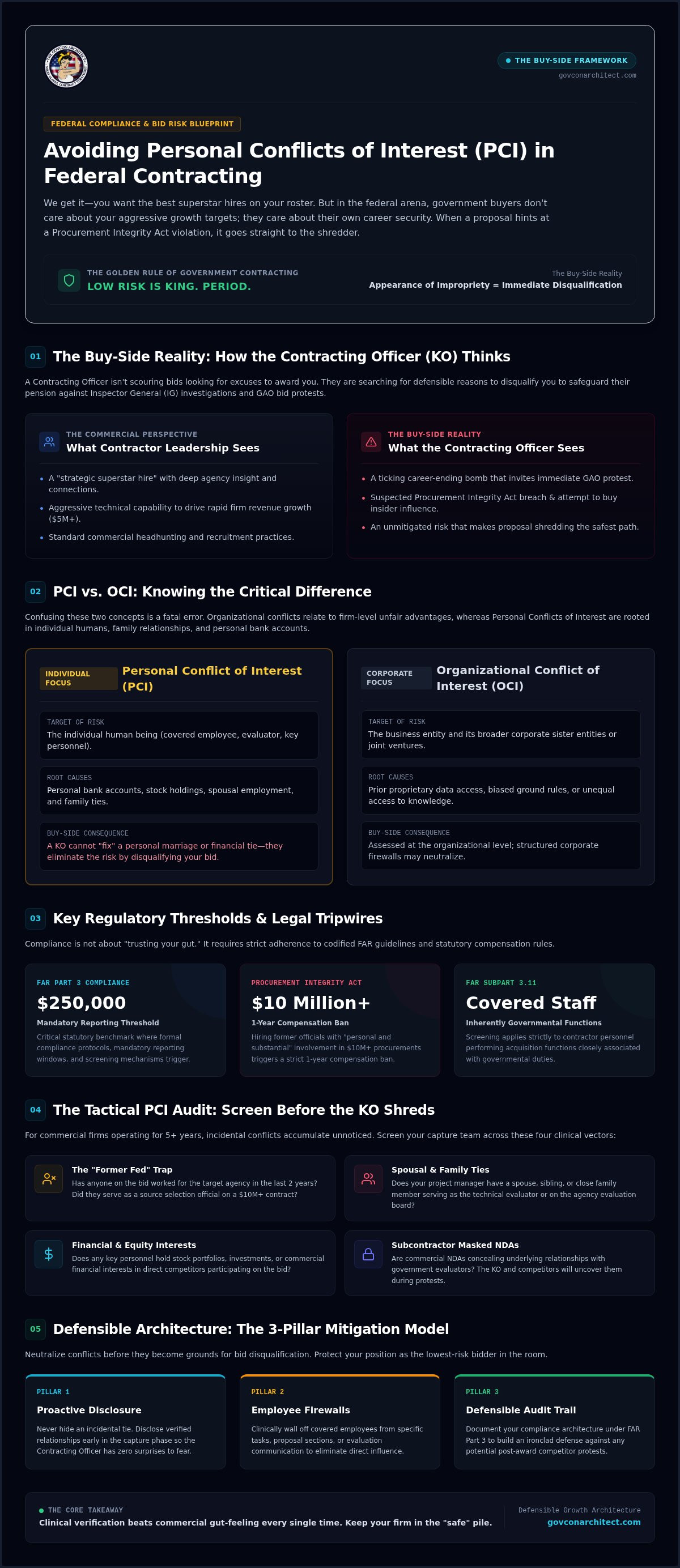
Don't confuse the two. An Organizational Conflict of Interest (OCI) is about the company's unfair advantage. A Personal Conflict of Interest (PCI) is about the human being. PCIs are harder to manage because they involve personal relationships and bank accounts. A KO can't "fix" your lead engineer's marriage to the agency's technical lead. They can only remove the risk by removing you. Avoiding personal conflicts of interest in federal contracting requires clinical precision at the individual level.
Identifying the Red Flags: A Tactical PCI Audit for Commercial Firms
Identifying red flags before the KO does is the difference between an award and a disqualification letter. If your firm has been operating for 5+ years, you likely have incidental conflicts you haven't noticed. It's not just about the CEO. It's about your "covered employees." Per FAR Subpart 3.11, a covered employee is a contractor employee who performs acquisition functions closely associated with inherently governmental functions. Screen them early or lose the bid later.
The "Former Fed" trap is a classic bid-killer. You think you're hiring a strategic genius. The KO thinks you're buying an unfair advantage. If that hire was a source selection official on a $10 million plus procurement, they might be legally banned from taking your money for a year. Financial interests also trigger alarms. It isn't just about stock portfolios. It's about spousal employment and family ties. If your project manager's sister is the technical evaluator, your bid is dead on arrival. Avoiding personal conflicts of interest in federal contracting requires you to see these connections as the government does: pure risk.
The Internal Audit: Questions You Must Ask Your Team
Stop guessing and start auditing. Ask your capture leads: Does any team member have a financial interest in a competitor? Has anyone on this bid worked for the target agency in the last two years? Do NDAs with subcontractors hide relationships with government evaluators? These aren't just HR questions. They are survival questions. If an NDA masks a conflict, the KO will find it during the protest phase anyway.
Leveraging Your Commercial Success Without Triggering Risks
Established firms often stumble because they treat federal hiring like commercial headhunting. It isn't. To maintain a low-risk bidder strategy, you must screen for these connections during the capture phase. Avoiding personal conflicts of interest in federal contracting is about clinical verification, not "trusting your gut." If you need an expert to review your team's risk profile, you should schedule a strategy session to lock down your compliance architecture.
The Low-Risk Mitigation Strategy: How to Neutralize Conflicts
Mitigation isn't an apology. It's a structural correction. On the Buy-Side, a Contracting Officer isn't impressed by your "good intentions." They want a paper trail that protects their career from a GAO protest. If you spot a conflict, disclose it immediately. Waiting for the KO to find it is a fast track to the disqualification pile. A proactive approach to avoiding personal conflicts of interest in federal contracting turns a liability into a proof point of your firm's maturity.
Your strategy must be clinical. Under 41 U.S.C. 2303, the government mandates policies to prevent these conflicts and the misuse of non-public info. A weak mitigation plan is basically a post-it note on a dumpster fire. It shows you recognize the risk but lack the discipline to fix it. That's a red flag. Avoiding personal conflicts of interest in federal contracting is what keeps you in the "low-risk" category.
Structuring Your PCI Mitigation Plan
Your plan needs teeth. It should follow a strict, documented logic:
- Identify: Name the "covered employee" and the specific conflict.
- Firewall: Implement hard barriers like server access restrictions and physical office separation.
- Certify: Provide the KO with a signed certification of ongoing monitoring.
When to Walk Away: The No-Bid Decision
Sometimes, the conflict is unmitigatable. If your key hire was the literal architect of the RFP, no firewall will save you. Recognizing these "bid killers" early prevents you from making common federal proposal writing mistakes that burn through your capture budget. If the risk can't be neutralized, walking away is the only way to protect your reputation for the next pursuit.
Building a Defensible Compliance Architecture for Long-Term Success
Stop playing compliance roulette. Accidental compliance is just luck, and luck isn't a strategy for established firms. If you have $5M+ in revenue, avoiding personal conflicts of interest in federal contracting must be a core component of your structural DNA. You need a Fractional Federal Strategy Advisor who understands the hidden buy-side mechanics that lead to disqualification. This isn't about checking a box once a year. It's about a monthly retainer that provides constant, proactive risk assessment. The government awards contracts to firms they can trust to stay out of the Inspector General's office. Low risk is king. Your low price won't save you if the KO thinks you're a liability to their career.
Integrating PCI Checks into Your Capture Sprint
You can't wait until the proposal is due to look for red flags. That's amateur hour. Bake these clinical audits into your Capture & Proposal Sprint from day one. This ensures your technical proposal remains compliant with Section L and M risk criteria before the evaluators even open the file. If you identify a conflict during the sprint, you can actually build a firewall or pivot your staffing. If you wait until the last minute, you're just submitting a donation to the agency's shredder. Avoiding personal conflicts of interest in federal contracting during the capture phase is how you maintain a clean, low-risk profile.
Next Steps: Securing Your Federal Revenue Stream
Building a predictable federal revenue stream isn't a hobby. It requires a 6 to 12 month commitment to develop a real federal engine. We don't serve pre-revenue firms because we focus on scaling established success with professional sobriety. Stop guessing which strategic hires are going to trigger a GAO protest and start winning with an architecture built on buy-side reality. It's time to move from hope to logic.
Stop guessing and start winning. Book your 15-minute get-to-know-you call with Nikki Gianni.
Secure Your Bid with a Low-Risk Architecture
The government buyer isn't your friend. They're a bureaucrat protecting their pension. If you hand them a proposal with a hidden conflict, you aren't being strategic; you're being a liability. A Personal Conflict of Interest is a bid-killer because it triggers the evaluator's fear of protests. You now know how to audit your covered employees and why a clinical firewall is the only way to satisfy a skeptical Contracting Officer. Low risk is king.
Nikki Gianni spent 22 years on the Buy-Side. She knows where the traps are hidden. For firms with $5M+ in revenue, avoiding personal conflicts of interest in federal contracting is about structural integrity. You need a defensible architecture that stands up to scrutiny. You've built a powerhouse business. Don't let a missing disclosure shred years of hard work.
We're here to help you navigate the minefield so you can focus on winning.
Frequently Asked Questions
What is a personal conflict of interest in federal contracting?
A Personal Conflict of Interest (PCI) occurs when your employee has financial interests or personal relationships that could bias their advice to a government agency. It isn't just about bribes; it's about anything that makes a Contracting Officer nervous. On the Buy-Side, even the appearance of a conflict is a bid-killer. Avoiding personal conflicts of interest in federal contracting is about identifying these human-level risks before the government shreds your proposal.
How do I disclose a potential PCI to a Contracting Officer?
You must report any identified PCI violation to the Contracting Officer in writing as soon as it's identified. Don't wait for them to find it; that's how you get disqualified. Your report needs a clinical description of the violation and a clear list of mitigation or disciplinary actions taken. Proactive disclosure shows you're a low-risk partner who values structural integrity over hiding mistakes. We help you build these defensible protocols.
Can a former government employee work on my federal bid?
Yes, but only with a documented ethics clearance. If they were a source selection official on a procurement over $10 million, they might be under a one-year compensation ban. Others have lifetime bans on specific matters they worked on personally and substantially. Hiring a "Former Fed" without a tactical cooling-off analysis is the fastest way to trigger a protest. We help you screen these hires to keep your bid low-risk.
What happens if I fail to report a personal conflict of interest?
Failure to report is a career-ender. At best, the Contracting Officer disqualifies your firm to protect the agency. At worst, you face criminal penalties under 18 U.S.C. 216, which can include up to five years of imprisonment and heavy fines. Avoiding personal conflicts of interest in federal contracting isn't just an ethical choice; it's a survival strategy to keep your $5M plus revenue stream safe from federal investigators and agency audits.
How does a PCI differ from an organizational conflict of interest (OCI)?
A PCI focuses on the individual employee performing acquisition functions who has outside financial interests or relationships. An OCI focuses on the corporate entity gaining an unfair competitive advantage, like having unequal access to non-public information. While they're different, an unmanaged PCI often creates an OCI. The Buy-Side doesn't care about the labels; they only care that either one makes your bid an unacceptable risk to their own job security.