
Alternatives to a Full-Time Proposal Writer: Compare Your Options

Article by
Nikki Gianni
Nikki Gianni is a seasoned business strategist and government contracts coach, dedicated to helping businesses successfully navigate the complexities of government contracting. With over 22 years of experience in Department of Defense contracting, including managing $20 billion in federal awards, Nikki has developed the innovative GovReady Blueprint™ Framework, a comprehensive 90-day program designed to prepare businesses to compete for and win lucrative contracts at the federal, state, and local levels. Nikki's approach emphasizes not just gaining contracts but also enhancing overall business profitability.
Before becoming a business owner, Nikki was active-duty Air Force for 10 years, then spent another 15 years as a civil servant with the DOD. Now she's an empty nester living in Southern California who loves spending time with her 22-year-old son, Lex and her 2 Mini Aussies, Tony & Carmela, doing home improvement and crafts projects, and networking.
A full-time proposal writer may be the wrong hire, even when your federal pipeline is active. The alternatives to a full-time proposal writer aren’t simply cheaper ways to produce pages. They’re different ways to manage capacity, pursuit decisions, and bid risk. If your workload rises and falls with opportunities, a permanent role can leave you paying for capacity you don’t consistently need.
And if the real gap is deciding which bids deserve resources or how to address evaluator priorities, more writing won’t fix it. Government buyers assess whether your approach is credible and low risk, not how many polished sentences fit on a page. This comparison covers hiring, freelance, agency, internal-team, and advisory models so you can identify whether you need writing capacity, proposal management, or buy-side pursuit strategy. You’ll see what each model can solve, where it falls short, and how to match support to your pipeline without mistaking more pages for a stronger pursuit.
Key Takeaways
- Compare alternatives to a full-time proposal writer by flexibility, internal ownership, continuity, and strategic depth, not just by who can produce pages.
- Identify whether the real gap is writing capacity, proposal management, or pursuit strategy before adding fixed capacity. More words won’t rescue the wrong bid.
- Match recurring pipeline demand to ongoing support, and reserve focused help for a defined, high-stakes pursuit.
- RETAINER · MONTHLY - Fractional Federal Strategy Advisor and PER-PURSUIT · PROJECT - Capture & Proposal Sprint address distinct needs with buy-side insight informed by Nikki Gianni’s 22 years of experience.
Why a Full-Time Proposal Writer May Not Solve Your Federal Bid Problem
Proposal work is real. So is the risk of hiring for the wrong gap. A full-time writer can add drafting capacity, but that doesn’t automatically solve weak opportunity selection, unclear ownership, or positioning that misses what the government is evaluating. Before weighing alternatives to a full-time proposal writer, separate the work: production creates and edits proposal content; proposal management coordinates schedules, inputs, and reviews; capture qualifies and shapes an opportunity; federal strategy aligns the pursuit with buyer priorities and risk considerations.
The government doesn’t score prose in a vacuum. It needs confidence that your claims are supported and your approach is credible. The Federal Acquisition Regulation (FAR) provides the framework for federal procurement, including fair competition. A polished response that leaves delivery risk unresolved is still a weak answer. Elegant formatting can’t teach an evaluator to ignore a gap.
Is your bottleneck writing capacity or pursuit judgment?
If qualified opportunities keep generating recurring document work, production capacity may be the constraint. If your team can’t determine whether to bid, connect evidence to requirements, or make positioning decisions, the gap is strategic. Unclear requirements call for disciplined interpretation. Weak evidence calls for substantiation. Decisions no one owns call for accountable leadership, not another set of hands on the keyboard.
What does a full-time proposal writer typically address?
An employee may draft, edit, coordinate contributors, and build institutional knowledge over time. Those contributions can matter when proposal demand is steady and internal ownership is clear. But don’t assume the job title includes capture leadership, evaluator insight, or authority to make pursuit decisions. Scope depends on the person and how the role is defined.
Fractional proposal strategy provides specialized pursuit expertise when needed, without creating a full-time role. It addresses the gap between producing pages and shaping a defensible bid. For a closer look at the management side, see this guide to federal proposal management and strategic risk mitigation. The right support depends on the actual constraint. Diagnose first; staff second.
Compare Five Alternatives to a Full-Time Proposal Writer
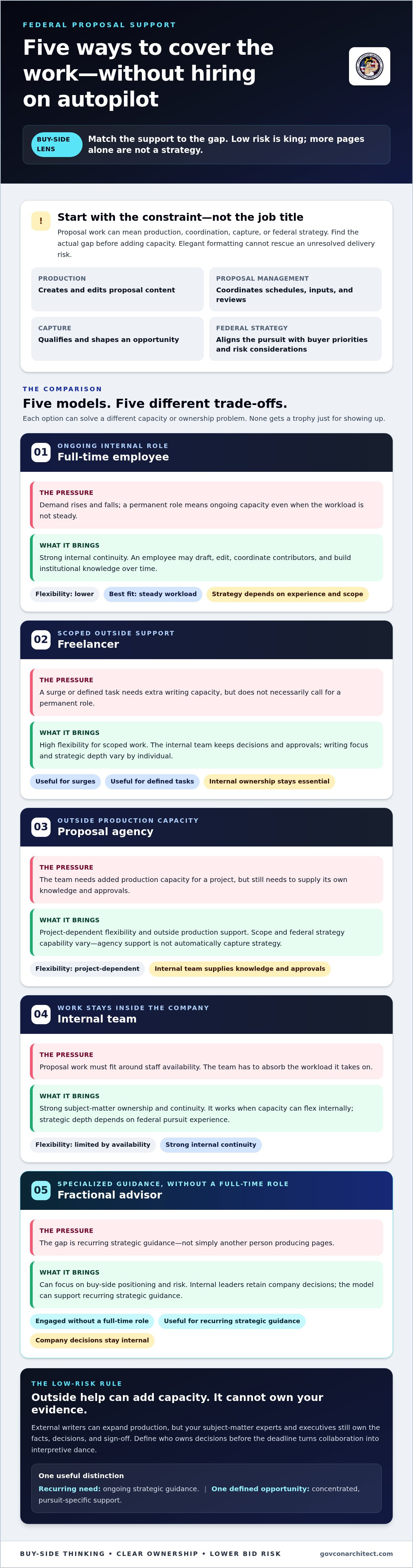
The best fit depends on what you need covered: document production, internal ownership, continuity, or pursuit judgment. These alternatives to a full-time proposal writer solve different problems. No single model gets a trophy just for showing up.
| Model | Flexibility | Ownership and continuity | Strategic depth | Fit for variable demand |
|---|---|---|---|---|
| Full-time employee | Lower; ongoing role | Strong internal continuity | Depends on experience and defined scope | Best when workload is steady |
| Freelancer | High for scoped work | Internal team retains decisions and approvals | Often writing-focused; varies by individual | Useful for surges or defined tasks |
| Proposal agency | Project-dependent | Internal team supplies knowledge and approvals | Scope and federal strategy capability vary | Can add outside production capacity |
| Internal team | Limited by staff availability | Strong subject-matter ownership and continuity | Depends on federal pursuit experience | Works when capacity can flex internally |
| Fractional advisor | Engaged without a full-time role | Internal leaders retain company decisions | Can focus on buy-side positioning and risk | Useful for recurring strategic guidance |
External writers can expand production capacity. They can’t supply your evidence or approve claims on your behalf. Your subject-matter experts and executives still own the facts, decisions, and sign-off. Agencies also differ: a proposal-production scope isn’t automatically federal capture strategy. The U.S. Government Accountability Office on Federal Contracting offers context on the complexity of this work. Low-risk bids need clear ownership, not a mysterious handoff.
Freelancer, agency, or internal team: where does the work sit?
With a freelancer or agency, writing capacity sits outside the company; content, evidence, and approvals remain internal. An internal team keeps the work closer to subject-matter experts, but must absorb the workload. Define who owns decisions before deadlines turn collaboration into interpretive dance.
Fractional advisor or per-pursuit support: what changes?
RETAINER · MONTHLY - Fractional Federal Strategy Advisor supports ongoing strategic needs. PER-PURSUIT · PROJECT - Capture & Proposal Sprint focuses on a defined opportunity. One provides recurring guidance; the other provides pursuit-specific support. To discuss which need your pipeline presents, discuss your federal pursuit support needs.
How to Choose the Right Proposal Support Model for Your Federal Pipeline
Choose support according to the capability gap and pursuit pattern, not habit. A four-step decision process keeps the choice tied to actual demand instead of defaulting to a hire because the next deadline looks intimidating.
- Diagnose the gap. Identify whether you lack writing capacity, proposal coordination, opportunity judgment, or alignment with buyer priorities.
- Assess pipeline consistency. Recurring pursuits may justify ongoing capacity or advice. One defined opportunity may call for concentrated support, not a permanent role.
- Map internal ownership. Name who supplies evidence, validates claims, makes bid decisions, and approves the response. External support can’t make unowned decisions disappear.
- Select support. Match the model to the work, timing, and expertise your team needs.
Low-risk positioning depends on more than polished language. Evidence must support the claims, the response must address the solicitation, and the approach must align with its evaluation criteria. If those connections are weak, adding writers may produce more pages that still miss the point.
What signals point to a recurring strategic need?
Repeated pursuits, ongoing leadership decisions about where to compete, and continuing alignment between pipeline choices and federal buyer priorities can signal a recurring advisory need. In that case, consider ongoing federal strategy support rather than treating every opportunity as an isolated writing assignment.
When is a defined pursuit the better unit of support?
A specific opportunity with concentrated capture or proposal needs may call for a defined project. Focus the work on that pursuit: its requirements, your evidence, the team’s responsibilities, and how the response will address evaluation priorities. Clarify federal proposal team roles so decisions and inputs have owners. That’s how you reduce avoidable gaps, not by hoping everyone knows who’s doing what.
A Buy-Side-Informed Alternative: Match Support to the Federal Pursuit
The GovCon Architect brings direct experience as a government buyer, evaluator, awarder, and contract administrator to federal pursuit decisions. That perspective shifts the question from “How do we write more?” to “What will help the government assess this offer as aligned, supported, and lower risk?” Nikki Gianni brings 22 years of buy-side experience. Useful when the stakes call for more than a grammar pass.
What buy-side insight changes in a proposal?
Evaluators need to assess whether a response addresses the solicitation, supports its claims with credible evidence, and presents an approach that inspires confidence in delivery. A response can be polished and still leave those questions unanswered. Buy-side-informed guidance helps connect your proof to the government’s stated evaluation priorities. Explore federal proposal compliance to see how disciplined alignment supports a clearer, more defensible response.
What should leaders expect from advisory support?
Advisory support is about strategy, preparation, and positioning, not maximizing page count or guaranteeing an award. For continuing pipeline and leadership decisions, RETAINER · MONTHLY - Fractional Federal Strategy Advisor provides ongoing strategic guidance. For a defined opportunity that needs concentrated capture and proposal guidance, PER-PURSUIT · PROJECT - Capture & Proposal Sprint focuses on that pursuit. Distinct needs. Distinct engagement models.
These alternatives to a full-time proposal writer are intended for established commercial firms with $5M+ in annual revenue and 5+ years of proven delivery. Leaders assessing the broader work can review federal proposal development consulting. The value is clearer pursuit judgment and stronger alignment, not a promise that anyone can control the outcome.
Choose Support That Strengthens the Pursuit
The right support model depends on the gap you need to close. Hire for steady proposal workload; use flexible writing capacity for defined production needs; bring in strategic guidance when bid selection, evaluator priorities, or risk positioning need attention. Match the commitment to your pipeline, not to the comforting idea that one role can solve everything.
The best alternatives to a full-time proposal writer do more than keep pages moving. They help your team make clear decisions, support claims with evidence, and present a credible, low-risk approach. Nikki Gianni brings 22 years of buy-side experience as a government buyer, evaluator, awarder, and contract administrator. That perspective informs support aligned with how government assesses a pursuit, without promising an outcome no advisor can control.
If your federal pipeline is active and the support gap is still unclear, a focused conversation can help you identify what the pursuit actually needs. You don’t have to solve every capacity problem with a permanent hire.
Choose deliberately. Build the support structure your next federal pursuit deserves.
Frequently Asked Questions
What are the best alternatives to hiring a full-time proposal writer?
The best alternatives to a full-time proposal writer include freelancers, proposal agencies, internal teams, and fractional advisors. A freelancer or agency can add production capacity; an internal team retains day-to-day ownership; an advisor can address strategy beyond drafting. The right fit depends on how often you pursue bids, what expertise is missing, and who will supply evidence and approve decisions. No model earns points just for being fashionable.
Is a freelance proposal writer enough for federal contracts?
A freelance proposal writer may be enough when your opportunity is qualified, your subject-matter experts can provide sound evidence, and your internal team owns decisions and approvals. The writer’s federal proposal experience and assigned scope also matter. If the gap is deciding whether to bid, shaping the pursuit, or aligning your positioning with evaluation priorities, writing support alone may leave those strategic questions unanswered.
Can a fractional federal advisor replace an in-house proposal writer?
Not automatically. A fractional advisor provides strategic guidance without a full-time role, while an in-house writer may handle recurring drafting, editing, and coordination. One doesn’t necessarily replace the other. If your workload is consistently document-heavy, internal writing capacity may still be needed. If leadership needs recurring federal pursuit guidance, RETAINER · MONTHLY - Fractional Federal Strategy Advisor is structured for ongoing strategic support.
When should a company use per-pursuit proposal support instead of ongoing advisory?
Use per-pursuit support when a defined opportunity needs concentrated capture and proposal guidance, rather than continuing support across a federal pipeline. PER-PURSUIT · PROJECT - Capture & Proposal Sprint is designed for a specific pursuit. Ongoing advisory may be a better fit when leadership faces recurring bid decisions or needs continuing alignment. The distinction is the unit of need: one opportunity or an ongoing strategic requirement.
How do I decide whether my company needs proposal writing or federal capture strategy?
Look at where work stalls. If the opportunity is chosen, requirements are understood, and evidence is ready, but the response needs drafting or editing, writing capacity may be the gap. If your team is unsure what to pursue, how to position its strengths, or how to address buyer priorities and perceived delivery risk, assess the capture strategy first. More pages won’t fix a pursuit decision that hasn’t been made.